
Mist rising across a broad river with layers of rainforest beyond.

Source-sink dynamics facilitate mammal recovery after unsustainable hunting

Spatial models examined how hunting associated with selective-logging camps affected six mammal species, and whether populations could recover after logging ended while subsistence hunting continued.

Concentrated hunting pressure depleted wildlife around logging camps; connected forest later supported modeled recolonization.

Griffiths, B. M., Nirenblatt, E., Romulo, C., Bowler, M., Briceño Huerta, F., & Gilmore, M. P.

Ambio · 2026 · DOI 10.1007/s13280-026-02384-0

Read paper ↗

Key findings

01 · Question

How did unsustainable hunting from illegal loggers affect the abundance of key game mammals?

Participatory mapping and interviews documented intensive hunting associated with logging camps and severe declines in game and fish available to Sucusari families.
02 · Result

Models showed game depleted rapidly during logging.

Spatial models predicted severe depletion or local extirpation of six hunted mammal species, with the magnitude and pace differing among species. Populations recovered under normal subsistence hunting conditions due to habitat connectivity.

03 · Significance

Connected source areas supported recovery after logging ended.

Most modeled populations recovered despite continued subsistence hunting because pressure fell and animals could disperse into depleted areas from surrounding forest, showing that habitat continuity is critical for sustainable hunting.

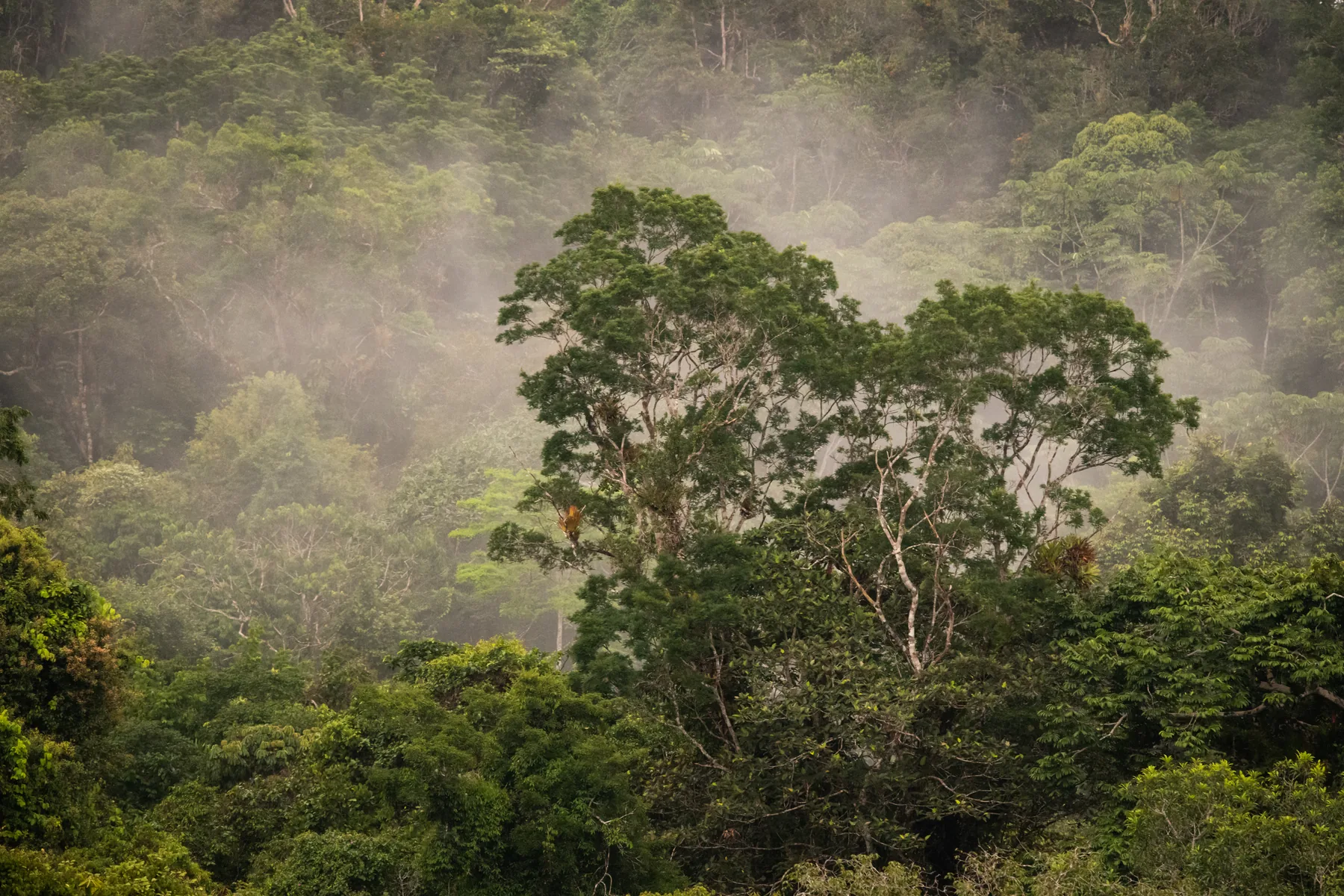
Misty rainforest canopy in the Peruvian Amazon.

Brief Background

Illegal loggers invaded Maijuna lands in the early 2000s, and exclusively hunted for their food. Over the course of about ten years, the loggers killed most mammals in the river basin, leaving the Maijuna with food insecurity. We used interviews with Maijuna elders and leaders paired with biodemographic modeling to show the likely loss of key game mammals due to unsustainable hunting, and the subsequent recovery after loggers were evicted.

Illegal loggers hunt unsustainably from logging camps deep in the forest, causing rapid declines in game mammal abundance.

Loggers evicted, subsistence hunting continues from Maijuna community and allows mammal recovery.

Methods

Community knowledge paired with spatial population models

01 · Interviews

Participatory mapping and hunter interviews

A three-day community focus group mapped former logging camps in 2014. Semi-structured interviews with 14 hunters and a community leader documented perceived changes during and after logging. Weekly interviews with 19 hunters in 2018–2019 mapped hunting routes, encounters, and kills used to estimate spatial hunting pressure.

02 · Modeling

Spatially explicit biodemographic models

Models adapted the approach of Levi and colleagues to combine central-place hunting, species biology, growth, dispersal, and carrying capacity. Separate logging and post-logging pressure regimes were simulated for six mammal species from 2002 to 2020 using participatory data, hunter observations, and published biological parameters.

Results

Source-Sink System Ensures Recovery and Sustainability

01 · Pressure

Local depletion

Focus groups describe mass extirpation of game mammals, a result that is confirmed by biodemographic modeling.

02 · Source

Wildlife persists across connected forest

Broader forest retained animals beyond the most heavily hunted portions of the basin.

03 · Movement

Recolonization

After unsustainable hunting from loggers ended, dispersal could repopulate depleted areas at species-specific rates.

Publication Data Explorer · Figures 2–3

Compare modeled depletion and recovery

Choose one of the six modeled mammal species and one of the three archived model states. Values remain percentages of species-specific carrying capacity.

Modeled abundance

Loading validated Figure 2 data…

watershed mean

Tap or move across a 1 km cell to inspect its value and distance from Sucusari.
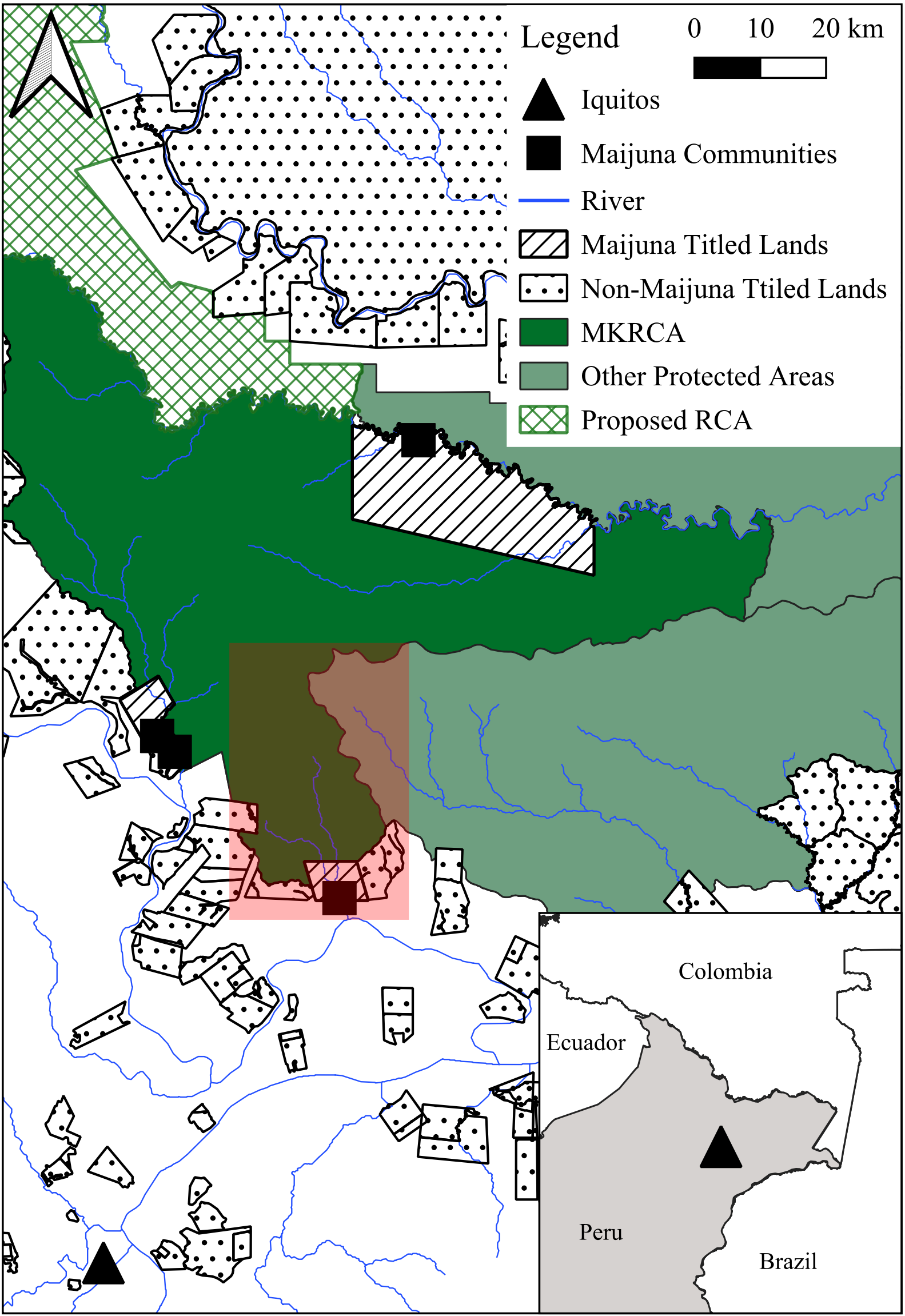
Regional map locating the study landscape near Iquitos within Peru, including protected areas, titled lands, rivers, and Maijuna communities.
0% · extirpated100% · carrying capacity

Sucusari community

Interactive map of modeled abundance.